Blog / Money / HL-011 ·

FairPath
Estimate a redundancy payout under the Fair Work Act. A gentle estimate for a rotten day, with fewer spreadsheets and more tissues.
- Web tool
- Money
- Live Apr 2026
- Web
What it is (for a very bad Tuesday)
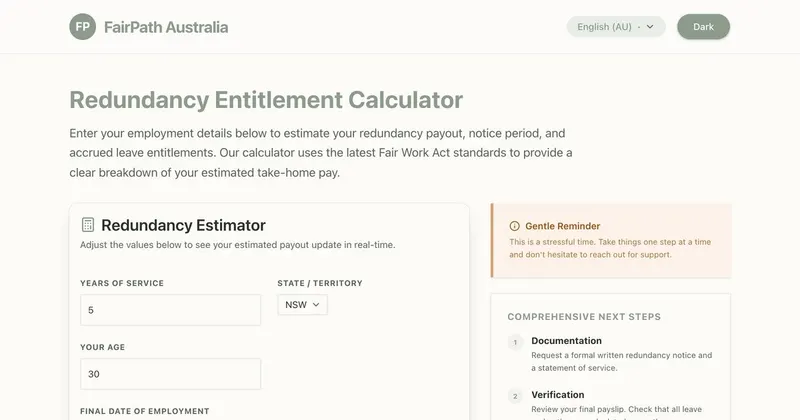
FairPath estimates what you may be owed if your job is made redundant in Australia. You enter your years of service, your age and your gross weekly pay. It then works out redundancy pay, notice pay, accrued annual leave and long service leave, and estimates tax and take-home pay.
It also explains the result in a plain sentence, such as how many weeks of redundancy pay and notice your years of service add up to. That's more than most HR letters manage in two pages.
Who it's for (anyone who just heard "restructure")
Australian employees who've just heard the word "restructure" and want a number before the next meeting. It's built to be calm, with a "gentle reminder" that this is a stressful time and you can take things one step at a time. It's the only part of the day that won't use the phrase "going forward".
How it works
The inputs are years of service, age, weekly pay, and a tick box for small business (fewer than 15 employees). For small businesses, the page notes you're generally entitled to notice but not redundancy pay.
The estimate is based on the National Employment Standards under the Fair Work Act, as updated for 2024. A table shows how the redundancy pay would change with a different number of years, which is handy for seeing what one more year would have been worth. Painful, but handy.
Around the number sit some practical extras:
- A next-steps checklist covering paperwork, checking your final payslip, Centrelink, your CV, interview prep and budgeting.
- Links to mental health and job-finding support.
- Pre-written prompts for an AI chat, if you'd like to talk it through.
- Language options, including Spanish and Chinese, and a dark mode.
The disclaimer says the figures are estimates and that your contract or agreement may give you more.
Lessons learned
- Design for how your user feels on the day. People using this are stressed, so the tool stays calm, plain and always offers a next step.
- Make an estimate show its limits. Saying your contract may give you more than the standard minimum keeps a rough number from being read as a promise.
- Ask for as few inputs as you can. Four fields were enough, and when you build by prompting an AI, every extra field is one more thing to describe and test.