Blog / Learning / HL-058 ·
Harfred Island
A block-building island game where kids earn new blocks by learning. A maths lesson with a boat in it, which is the best kind.
- Game
- Learning
- Live Oct 2026
- Web
- Lab pick
What it is (a very elaborate bribe)
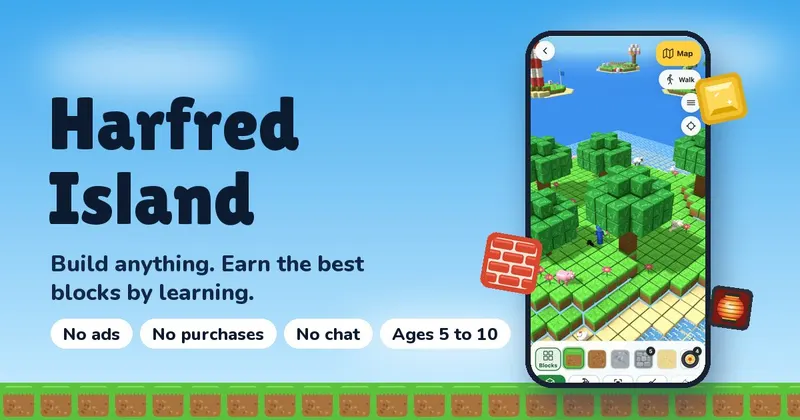
Harfred Island is a building game for kids aged about 5 to 10. You get a big blocky island made of shiny toy blocks, and you can build on it, dig into it, drive around it and sail off it. Tap to place a block. Tap to break one. A broken block goes back in the bag, so nothing is ever lost.
The twist is how you get the good blocks. Grass, dirt, stone, sand, planks and wool are free forever. The special ones, like glass, doors, lamps, wheels, sails and gold, are won by playing short games on five learning islands: Number Island for maths, Word Woods for reading and spelling, Sakura Isle for Japanese, Inventor's Lab for coding and science, and Move Meadow, which sends kids off the screen to do star jumps and hunt for leaves.
Each round is five questions and takes two or three minutes. A wrong answer shows why, with a hint and another go. Blocks are never taken away. Every question has a read-aloud button, so a five-year-old who can't read yet can still play.
The island has residents too. The family's soft toys and pets live there and sometimes make wishes, like a kennel for Puppy. Build it and the wish comes true. You can even print a build sheet and make it from real bricks, then step on one at 2am.
Who it's for (small builders, big negotiators)
Kids, and the grown-ups worried about screens. The game ends on its own: an island day lasts twenty minutes by default, then the sun sets, the residents say goodnight and everything saves. There are no ads, purchases, chat, streaks or notifications. It works offline and the data stays on the device.
Two kids can share a tablet with a builder each, or build on the same island on two devices. Grown-ups get a progress page in plain English, like "Working on: teen numbers".
How it was built
It runs on the web, iPhone and iPad from one codebase. Content follows the Victorian Curriculum from Foundation to Year 4.
The learning part adjusts itself. Each child has a rating for each skill, and each question has a difficulty. After every answer both numbers shift, a bit like chess rankings. The game aims for questions the child gets right about three times out of four. Two misses in a row steps down. Four right in a row steps up. Fast answers earn a small bonus, but being slow is never punished.
The world grew over time. It started as a small island and became 512 by 96 by 512 blocks, with the original island left untouched in the middle like the good china. There's also Race Bay, a racing area with its own tyres, pit stops and a podium.
The 495 read-aloud lines use a recorded human voice, with the device's own voice as backup.
Lessons learned
- Give the AI a checkable spec, not a wish. Each phase had a written spec with testable items, like the exact rule for stepping questions up and down, so the work could be checked while every human was asleep.
- Put your hard rules at the top of the spec. The specs open with ground rules, such as no streaks, no pressure timers and no network calls, so the AI follows them instead of guessing.
- Protect saved games when the world changes. When the world got bigger, the old save was kept and a browser test checked the move, so no kid lost their island.
- Don't trust tests that need a fast computer. The race tests were reworked so they no longer depend on frame rate when the machine is busy.